

Dubai Mortgage Guide 2026: What Buyers Need to Know Before Financing a Property
A practical guide to Dubai mortgages in 2026, including LTV limits, pre-approval, bank valuations, mortgage costs and how much cash buyers may need.
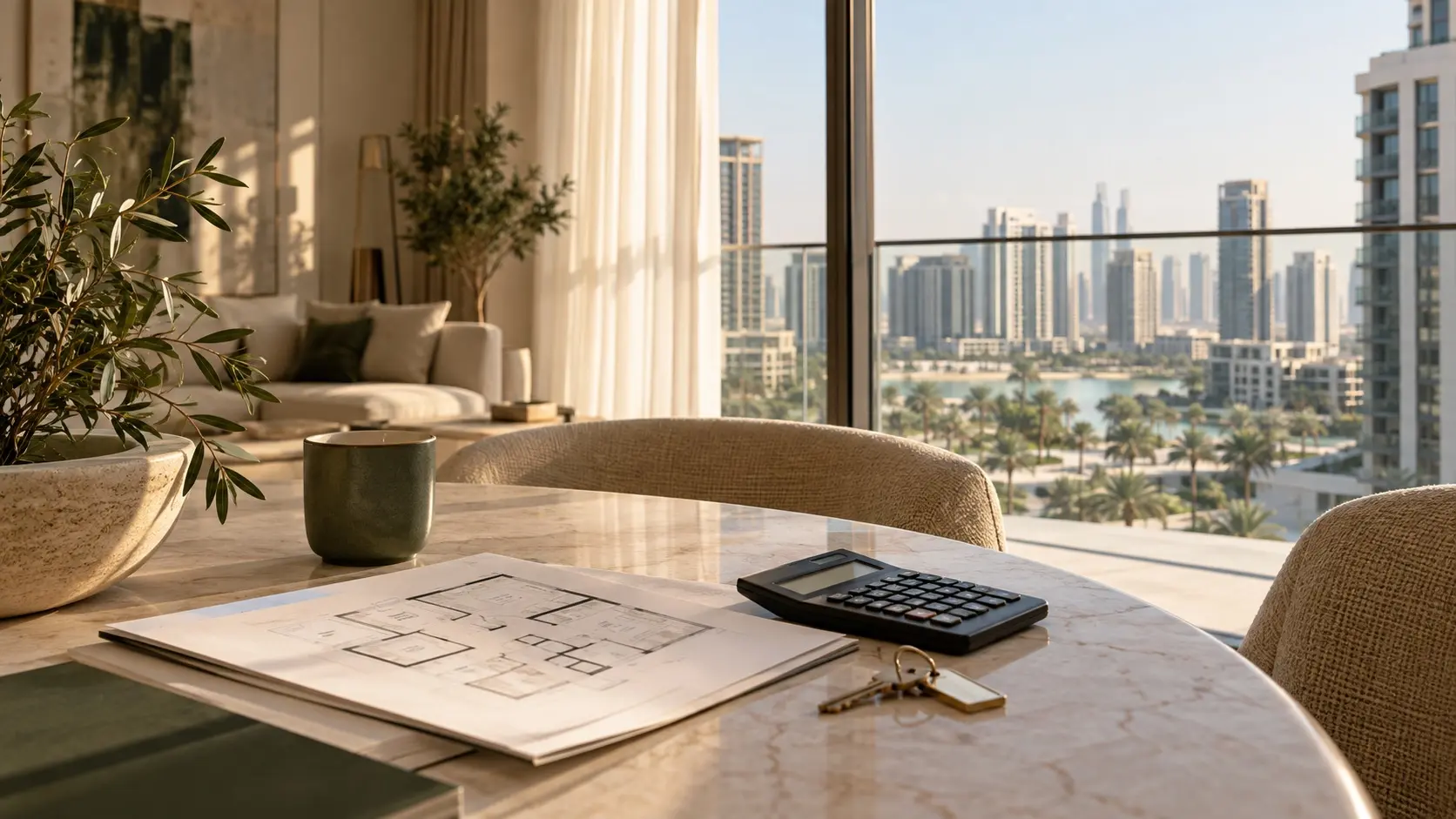
Buying a property with a mortgage isn't simply about finding the lowest interest rate. From affordability and loan-to-value limits to bank valuations and the cash you need to complete, understanding the financing structure before you choose a property can make the buying process considerably smoother.
For many buyers in Dubai, a mortgage makes it possible to purchase a property while retaining some of their capital rather than committing the full purchase price in cash.
But the first question shouldn't necessarily be:
How much will the bank lend me?
A better question is:
How much do I comfortably want to borrow?
That distinction matters.
Start with affordability, not the property
Before seriously viewing properties, establish what you are comfortable committing to the purchase.
Consider your available deposit, monthly repayment comfort, existing financial commitments, income stability, emergency savings and how long you expect to own the property.
A bank's willingness to lend a particular amount does not automatically mean borrowing the maximum amount is right for you.
Your property decision and your financing decision should work together.
How much can you borrow for a property in Dubai?
Mortgage lending in the UAE is subject to Central Bank loan-to-value, or LTV, requirements.
For expatriates purchasing their first owner-occupied property, the current maximum LTV is:
For UAE nationals purchasing their first owner-occupied property, the corresponding maximums are 85% and 75%.
Different limits apply to subsequent properties and off-plan purchases. Off-plan mortgage financing is subject to a maximum LTV of 50%. Mortgage terms are generally capped at 25 years. Source: Central Bank of the UAE
These are regulatory maximums—not a guarantee of what a particular bank will lend. The bank will still assess the borrower, income and liabilities as well as the property itself.
- Up to AED 5 million property value — maximum 80% financing
- Above AED 5 million — maximum 70% financing
Why mortgage pre-approval should come first
If you intend to use financing, obtaining mortgage pre-approval before seriously searching for a property can be useful for two reasons.
First, it gives you a more realistic understanding of the price range you can consider.
Second, when you find the right property, you are in a stronger position to proceed without beginning the financing conversation from scratch.
Pre-approval, however, should not be confused with final approval. The property itself still needs to satisfy the bank's requirements, including valuation.
Don't overlook the bank valuation
This is one of the most important aspects for a mortgaged buyer to understand.
The price you agree to pay for a property and the value assigned to it by the bank are not necessarily the same.
For example, suppose you agree to purchase a property for AED 3 million but the bank subsequently values it at AED 2.8 million.
The amount the bank is prepared to finance may then be calculated using that lower valuation, subject to the applicable lending rules and the bank's approval. That can mean you need to contribute more of your own cash than you originally anticipated.
This is why a buyer should retain some flexibility rather than calculate the cash requirement solely from the agreed purchase price.
It is also why we included an Estimated Bank Valuation field in our Buyer's Equity Calculator: buyers can model how a difference between purchase price and bank valuation may affect the cash they need.
Fixed or variable mortgage?
A fixed-rate mortgage provides repayment certainty for a defined period.
A variable rate can change as market rates change.
The important point is not simply to compare the introductory rates offered by different banks. Ask what happens after the initial fixed or promotional period ends.
The mortgage that looks cheapest on day one may not necessarily be the most suitable over the period you expect to hold the property.
Your comparison should therefore consider the broader financing structure, not just the headline rate.
What other mortgage costs should you allow for?
Your deposit isn't the only cash requirement when financing a property.
Depending on the transaction and lender, costs may include bank processing fees, property valuation fees, mortgage registration, insurance and other transaction-related charges.
Dubai Land Department currently charges 0.25% of the mortgage value for ordinary mortgage registration, in addition to applicable administrative and service fees. Source: Dubai Land Department
You should also understand the terms relating to early settlement, the expiry of any fixed-rate period and potential refinancing costs.
These amounts should be considered before committing all your available capital to the deposit.
Mortgage or cash: which is better?
There isn't a universal answer.
Buying with cash provides simplicity and removes financing costs.
Using a mortgage allows you to preserve liquidity and retain capital that could potentially be used elsewhere.
The better decision depends on factors including the cost of borrowing, what you could otherwise do with the capital, your expected ownership period, your tolerance for financial risk and your wider financial objectives.
For an investor in particular, the question should not simply be whether they can buy in cash.
The more useful question may be whether committing all that capital to one property is the most appropriate use of it.
Before you buy
A mortgage should not be something you think about only after finding a property you like.
Understand the financing structure early.
Know approximately how much cash you will need. Understand what happens if the bank valuation differs from the purchase price. Compare the mortgage beyond its introductory rate. And leave sufficient flexibility for the costs surrounding the transaction.
At Ikigai, we believe the financing decision should be considered alongside the property decision—not after it.
Choose the property and the capital structure with the same level of care.
Considering buying a property in Dubai?
Tell us what you're looking for and we'll help you understand the property options and the buying process.