

Dubai Real Estate Market Outlook 2026: A More Selective Market
Our Dubai real estate market outlook for 2026 looks at residential prices, villas, off-plan property, commercial real estate and what buyers and investors should watch.
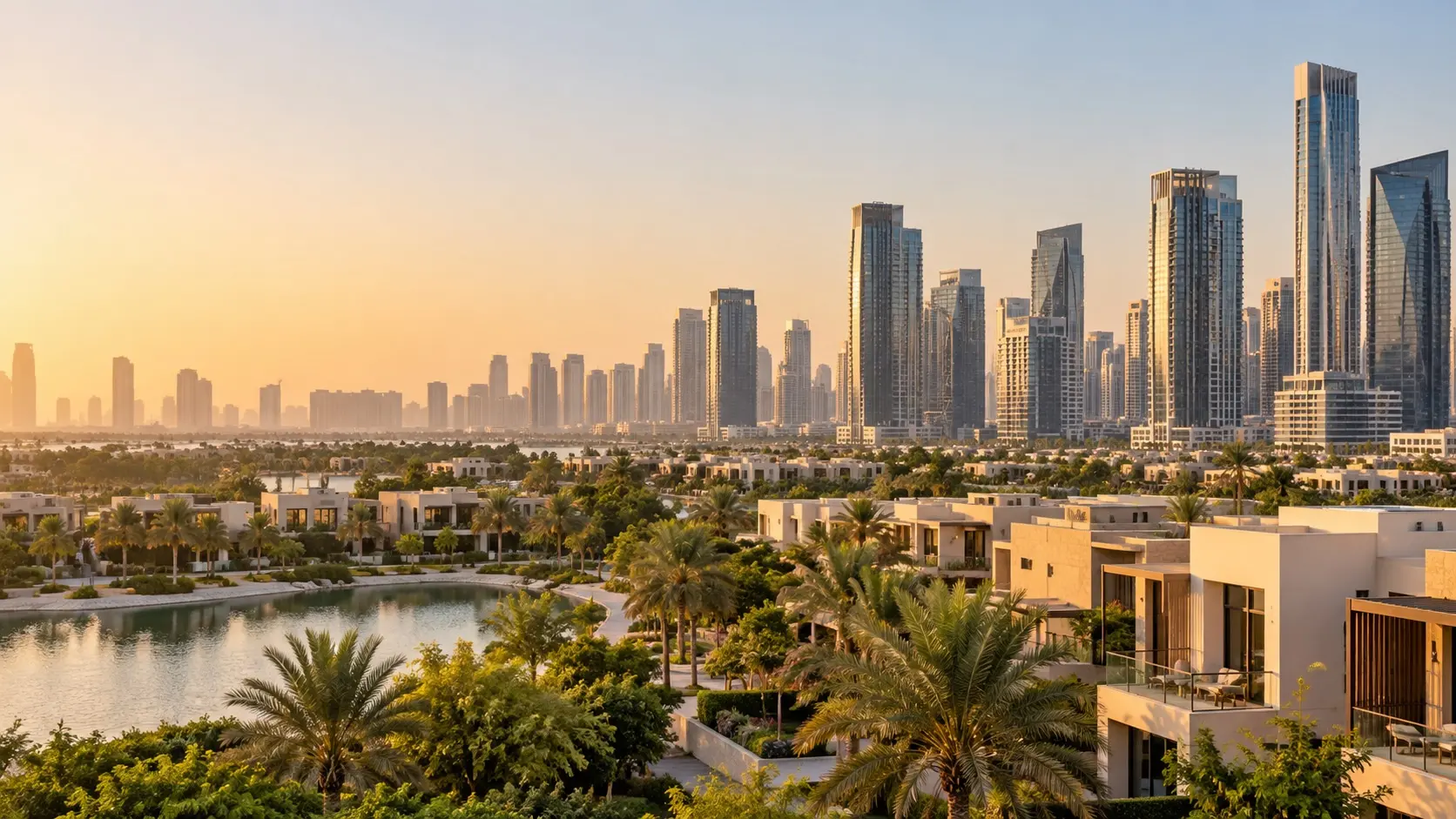
Dubai's real estate market in 2026 is becoming more selective. After several years of broad-based growth, residential prices have begun to moderate, while ready-property activity, off-plan sales and commercial real estate are showing different dynamics.
That doesn't necessarily make the market less interesting. It makes what you buy, where you buy and why you are buying increasingly important.
Earlier this year, ValuStrat forecast approximately 10% growth in Dubai residential capital values for 2026, with villas expected to outperform apartments. More recent data, however, shows a market that has moderated more quickly: its July index recorded residential values down 0.3% month-on-month and 1.6% year-on-year. At the same time, ready-home transactions increased 11.4% from June.
For us, that distinction matters.
Dubai is no longer a market where everything should be expected to move together.
Residential property: becoming more selective
For several years, Dubai experienced exceptionally broad residential growth. Rising values across many communities made it relatively easy to focus on the direction of the overall market.
The next phase is likely to require more discrimination.
Buyers are increasingly able—and need—to compare communities, developers, layouts, service charges, payment plans, handover schedules and competing supply before making a decision.
For homebuyers, that can be healthy.
A family buying a villa to live in for the next ten years should not evaluate a property in the same way as an investor looking primarily for rental income.
And neither should necessarily make the same decision as someone buying off-plan with a five-year investment horizon.
There are still opportunities. But increasingly, the right property for the right objective matters more than simply participating in the market.
What does the change in residential prices tell us?
One of the more significant developments this year has been the moderation in residential values.
ValuStrat's July 2026 data showed its citywide residential price index down 0.3% month-on-month and 1.6% year-on-year. Villas were down 0.4% for the month but broadly flat year-on-year, while apartment values were down 4.2% annually.
We don't see this as a reason to reduce the Dubai property market to a simple question of whether prices are “rising” or “falling”.
It is a reason to look closer.
At the same time as values were adjusting, July ready-home transactions increased 11.4% month-on-month. Off-plan still accounted for approximately 73% of residential sales, but activity in completed homes strengthened.
That combination tells a more useful story than a headline price movement alone.
Buyers are still active. They may simply be becoming more selective about where they see value.
Villas and townhouses remain interesting
One structural theme we continue to watch is demand for family homes.
Dubai has invested heavily in master-planned communities that combine homes with schools, greenery, leisure, retail and connectivity. At the same time, single-family homes remain a relatively limited part of the city's overall residential stock.
ValuStrat's 2026 outlook estimates villas and townhouses at less than 20% of residential stock and expects the year's new supply pipeline to remain heavily weighted towards apartments.
This helps explain why villas and townhouses remain an interesting part of the market.
But scarcity alone isn't enough.
A villa in the right community, with a good layout, sensible pricing and genuine end-user demand may behave very differently from a superficially similar property elsewhere.
Not every villa is automatically a good investment simply because villas are relatively scarce.
Community quality, future supply, property condition, plot and layout, service charges, accessibility and the depth of end-user demand all still matter.
Off-plan: look beyond the launch
Dubai's off-plan market remains an important part of overall transaction activity, with off-plan registrations continuing to represent the majority of residential sales.
For investors, this makes project selection particularly important.
A strong launch, attractive payment plan or well-known developer can all be relevant. But they are not, by themselves, an investment case.
We believe buyers should also consider what the surrounding market may look like by the time the property is handed over.
How much competing supply is expected?
Who is likely to rent or buy the property later?
How does the price compare with ready property in the area?
What needs to happen for the expected capital appreciation to be achieved?
And does the property still make sense if the market performs more moderately than expected?
A good off-plan decision should work beyond the launch day.
Commercial real estate is telling a different story
Dubai's office market has remained notably resilient.
CBRE reported approximately 94% office occupancy in Dubai in Q2 2026, with average office rents 13% higher year-on-year and prime rents up 16%. Its wider review also found the office and industrial sectors continuing to perform strongly despite moderation in residential property.
For us, commercial property is worth watching for another reason.
Office demand provides a window into the underlying economy.
Companies taking additional space, renewing leases or moving into better premises are making decisions about Dubai as a place to operate and grow.
That has implications beyond offices.
Businesses employ people. People require homes. Growing communities require retail, schools, services and infrastructure.
Commercial and residential real estate are different asset classes, but they are ultimately connected by the same city.
Property management is becoming part of the investment conversation
As Dubai's stock of investment property grows, another question becomes increasingly important.
Not only:
“What should I buy?”
But:
“How should I manage what I own?”
Tenant selection, rental positioning, maintenance, inspections, renewals and protecting the condition of the property all influence the owner's experience—and potentially the long-term performance of the asset.
Dubai's rental market is evolving too. In June 2026, Dubai Land Department launched its Flexi Rent initiative with participating property companies, allowing eligible properties to offer more flexible payment structures including monthly, quarterly and semi-annual instalments.
For landlords, developments like these reinforce the need to think about how properties are positioned and managed in an increasingly sophisticated rental market.
Property management should therefore not be viewed only as administration.
For an investment property, how the asset is managed after purchase is part of the investment decision itself.
Our view for the remainder of 2026
We remain positive about Dubai real estate.
But being positive about Dubai does not mean being positive about every property, every project or every price.
The market is giving buyers more reason to distinguish between asset classes, communities and individual properties. Residential values have moderated, ready-property activity has shown resilience, off-plan remains a major part of transaction volumes, and the commercial market continues to demonstrate different supply-demand dynamics. Source: ValuStrat
For buyers and investors, we believe the remainder of 2026 will increasingly reward careful selection, realistic expectations and a longer-term perspective.
That means understanding the objective first.
Are you buying somewhere to live?
Looking for rental income?
Seeking capital growth?
Diversifying an existing property portfolio?
Or allocating capital to commercial real estate?
The answer should influence what you consider—and what you reject.
At Ikigai, that remains our starting point:
Understand the objective first. Then find the real estate strategy that fits it.
In a market becoming more selective, that may be considerably more useful than trying to predict the next headline.
Sources: ValuStrat, CBRE and Dubai Land Department. Data referenced is based on reports available at the time of publication.
Considering a property in Dubai?
Tell us what you're looking for and we'll help you evaluate the options that make sense for your objectives.